
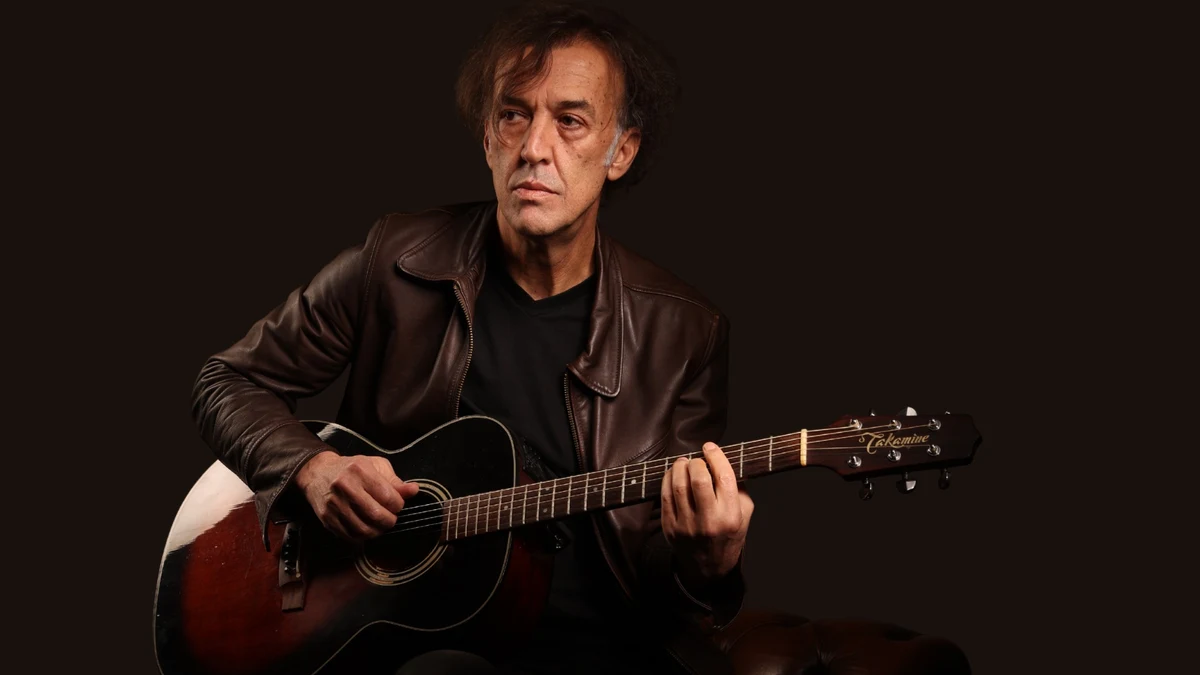
A guitar can take a song far from home without breaking its connection to the place where it began. Ali Amran has made that journey part of his art: Kabyle words carried by folk, pop and rock, with room for tenderness, doubt and the experience of departure.
From Iguariden to the first stage
Born Ali Koulougli on 20 May 1969 in Iguariden, in the Maâtkas area of Kabylia, he performs under a name that recalls his family: Amran was the name of one of his ancestors. The Kabyle spelling, Ɛli Ɛemran, places the artist within the language at the heart of his work.
Music became a practical pursuit early. His beginnings included writing songs and accompanying other performers, before his own voice moved to the foreground. At university in Tizi Ouzou, he provided music for the Meghres theatre troupe. A stage could be a place of experiment before it became a destination in its own right.
A guitar open to more than one world
Ali Amran’s approach connects Kabyle melody and language with an acoustic-guitar sound shaped by folk-rock, blues and pop. It is a conversation between musical traditions rather than a departure from one towards another.
In an interview with TSA, he recalled discovering artists including the Beatles, Cat Stevens, Simon and Garfunkel, Dire Straits and Pink Floyd, alongside listening to Idir, Aït Menguellet and the Abranis. Those listening habits help explain a creative outlook in which international influences and an Amazigh inheritance can sit naturally together.
A guitar arrangement can change the light around a melody. It can give a familiar language another rhythm and open it to a listener who has never heard it before. This is one way to understand the invitation in Ali Amran’s work: the music reaches outward while the words keep their own voice.
Making a path in the diaspora
In 2000, he moved to Paris and continued developing his work through performances, encounters and collaborations. Cafés, cultural gatherings and festivals offered places to build an audience. His path included an invitation from Idir to open a concert at the Zénith in Paris in 2007.
The movement between Kabylia and Europe is more than a line in a biography. It places the songwriter among people whose lives unfold across places, languages and forms of belonging. A song can speak from that experience without reducing it to a single feeling: exile may hold longing, possibility and uncertainty together.
Words with a human centre
Africultures describes a repertoire concerned with social and political life as well as love, freedom and tolerance. These themes give the music a human scale. Public questions enter the song through the lives of the people who have to live with them.
His recorded work includes Xali Sliman, Akk’ I D Amur!, Tizi n’ Leryah and Tidyanin. The 2023 album Ccix Lhesnawi s Temyafit revisits songs associated with Cheikh El Hasnaoui, bringing an earlier voice into his own musical approach.
A road that remains open
Ali Amran’s place in contemporary Amazigh music lies in this continuing exchange: between inherited melodies and new arrangements, between a home language and unfamiliar listeners, between memory and the next song.
For Agraw, the portrait is an invitation to follow that exchange with your own ears. Explore the recordings in his listening room and let the music supply the part a biography cannot.
Questions & answers
Who is Ali Amran?
Ali Amran, born Ali Koulougli in Iguariden in Kabylia in 1969, is a singer and songwriter whose work carries Kabyle words through folk, pop and rock arrangements. His Kabyle name is written Ɛli Ɛemran.
What shapes Ali Amran’s musical style?
His guitar-led approach connects Kabyle melody and language with folk-rock, blues and pop. The article explores how his work joins an Amazigh inheritance with international musical influences.