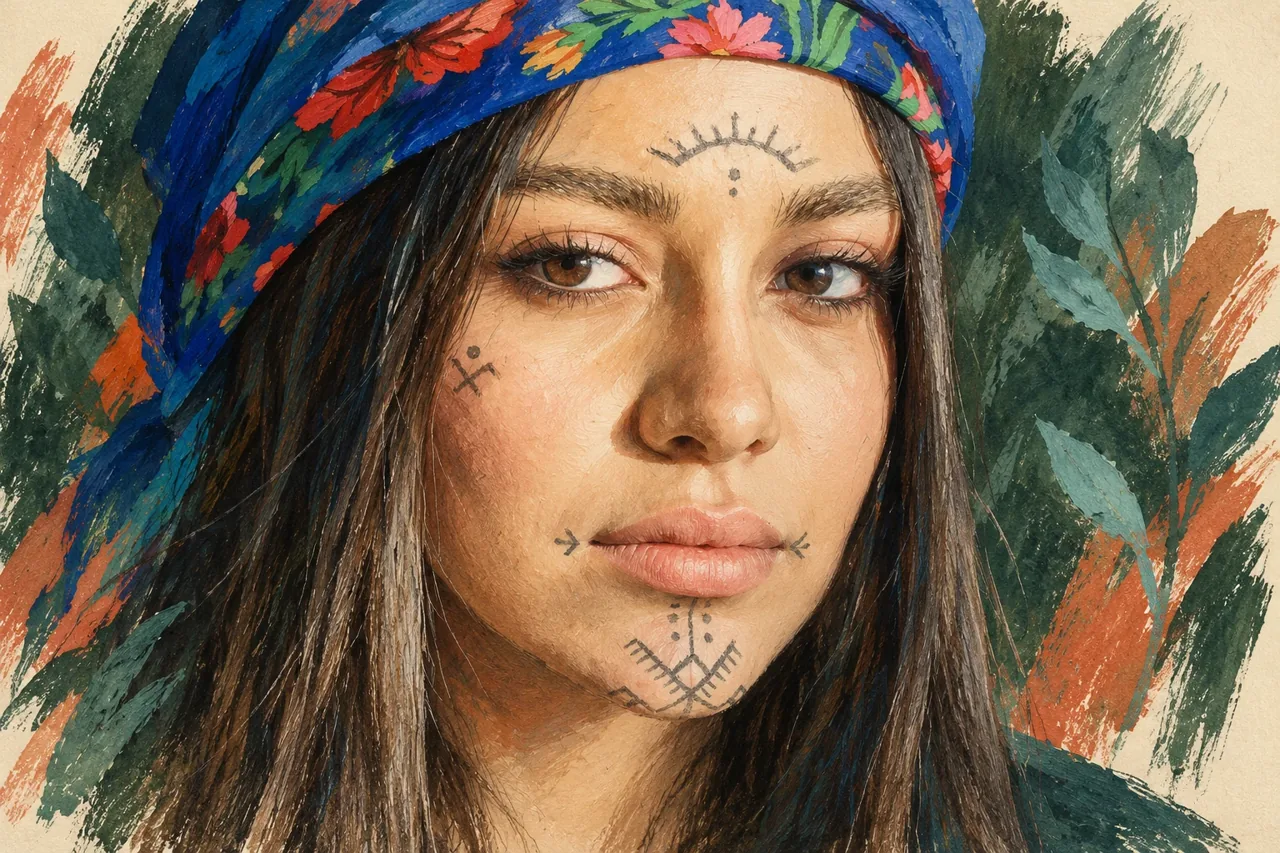
A line beneath the lip. A small constellation of dots. A diamond whose edges have softened with time. To look at an Amazigh woman’s tattoos is to encounter a history carried close to the body. To understand that history, we must also listen to the woman herself.
Beauty, belonging, protection and passages through life: Amazigh tattoos bring these themes into view. For Agraw, this heritage reaches beyond a catalogue of shapes. It leads to the people who gave those shapes a place in their lives.
A language with many local voices
Across North Africa, tattooing took different forms. A pattern on a chin, a mark between the eyebrows or a composition on a hand cannot be separated from its location, its wearer and the circumstances in which it was made. Even familiar shapes do not carry a single meaning everywhere.
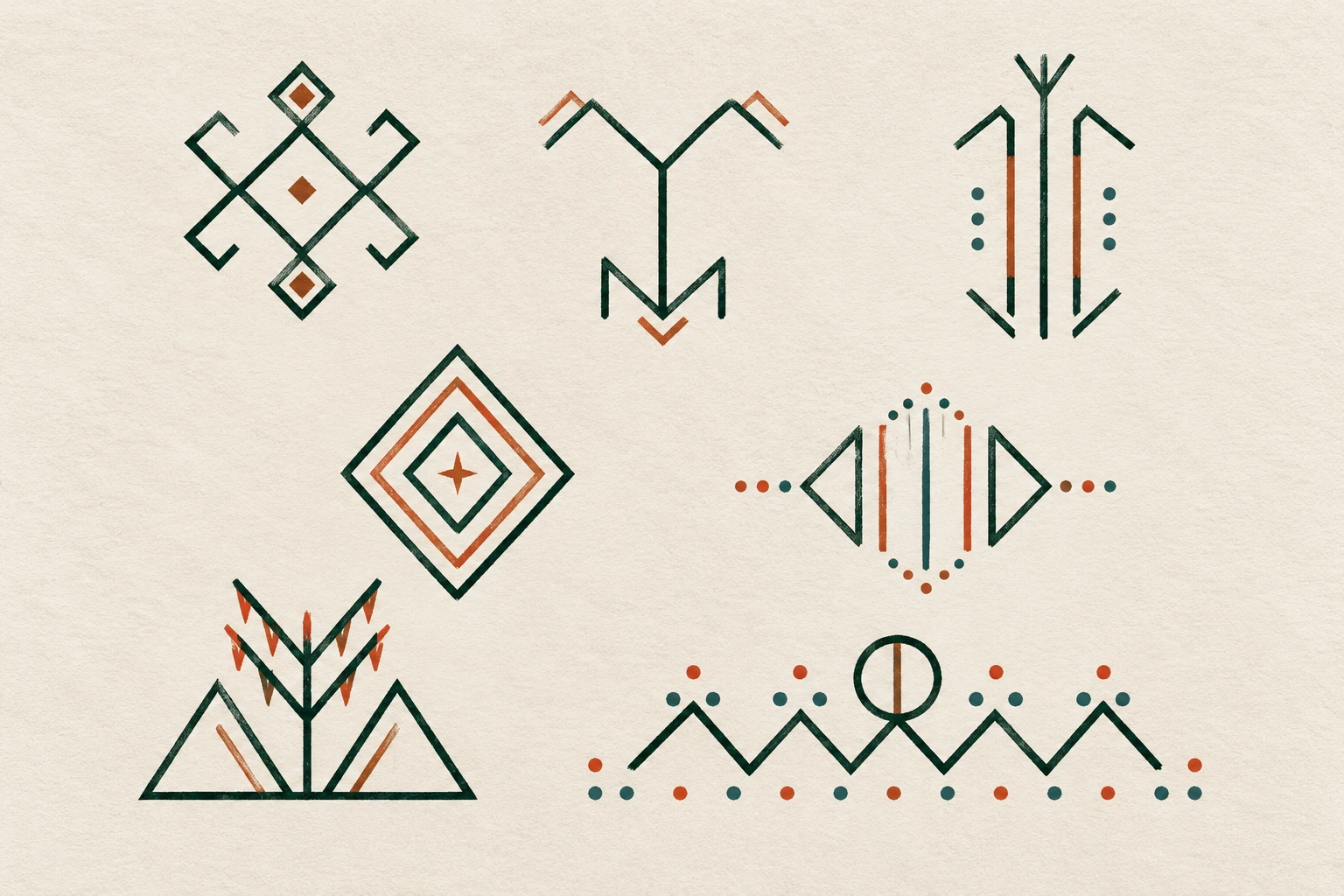
Lines, dots, angular crosses and lozenges recur in descriptions of these traditions. Their resemblance to a tree, an eye or a celestial form can invite interpretation, but resemblance alone is not proof. A neat online chart cannot replace a local name, a family account or a carefully documented testimony.
Reporting on photographer Yumna Al-Arashi’s work across Morocco, Algeria and Tunisia brings that human scale into focus. One woman, Zeyna, described a sun tattoo on her hand as part of her connection to farming and the land. Her attachment to that mark was personal. It reminds us that a wearer’s explanation can tell us more than a general definition. Read the reporting published by IWMF ↗
From skin to the world around it
Amazigh visual culture does not stop at the surface of the body. The Amazighs catalogue, published by Mucem and the Jardin Majorelle Foundation, places tattoos alongside jewellery, ceramics and textiles. It describes a shared vocabulary concerned with belonging, protection and the cycles of life.
Seen in that wider setting, a tattoo belongs to a world of making: the work of hands, the arrangement of colour, the care given to a garment or a home. Beauty and meaning need not be competing explanations. An adornment can be loved for its appearance while also carrying social, protective or intimate significance. Mucem: Amazighs ↗
Change, and the memories it leaves
Art historian Cynthia Becker’s research among Ait Khabbash communities in southeastern Morocco offers a specific account of change. She connects the decline of tattooing there with religious pressure and describes women’s embroidery as another way of expressing identity. This is a local history, not a timetable that can be applied to every Amazigh community.
Becker also records contrasting experiences. Some women recalled seeking tattoos; others described having been marked against their wishes. Remembering the tradition honestly means making room for both attachment and discomfort. Celebration should not silence a woman’s account of her own body. Cynthia Becker, Tents, Turbans, and Veils ↗
A heritage that artists can question
Contemporary art offers another way to approach this inheritance. In her 2017 photographic series Amazigh, Moroccan artist Safaa Mazirh used multiple exposures to superimpose tattoo designs on her own body. Becker’s later study reads the series as a reclamation of identity and a challenge to colonial ways of turning tattooed women into objects of observation.
That shift matters: the body can become a place from which to speak, rather than simply something for others to interpret. Read the publisher’s abstract of Becker’s study of Mazirh ↗
Keep the story beside the sign
For a cultural archive, preserving a design is only a beginning. Who remembers its name? Who made it? What does its wearer want to tell us—and what would she rather keep private? Those questions make space for a history that belongs to people, not just to images.
The task is not to turn every grandmother into a symbol of a vanished world. It is to recognise her as a person in this one: someone whose choices, knowledge and memories deserve attention. The marks may fade. Our willingness to listen need not.
Questions & answers
Do Amazigh tattoo motifs have one universal meaning?
No. The meaning of a mark depends on its location, wearer and circumstances. Similar shapes can have different meanings, so a wearer’s testimony or a documented local account is more reliable than a universal symbol chart.
How can Amazigh tattoo heritage be documented respectfully?
Keep the wearer’s account beside the image: ask about the mark’s name, who made it and what it means to her. Some women express attachment to their tattoos; others recall discomfort or a lack of choice. Both experiences belong in the record.