
A song can make a place feel close again. So can an old concert photograph, an artist’s name rediscovered after years, or a conversation that begins with Azul. These ordinary encounters are part of what a cultural website can offer: a way to return, and a reason to stay.
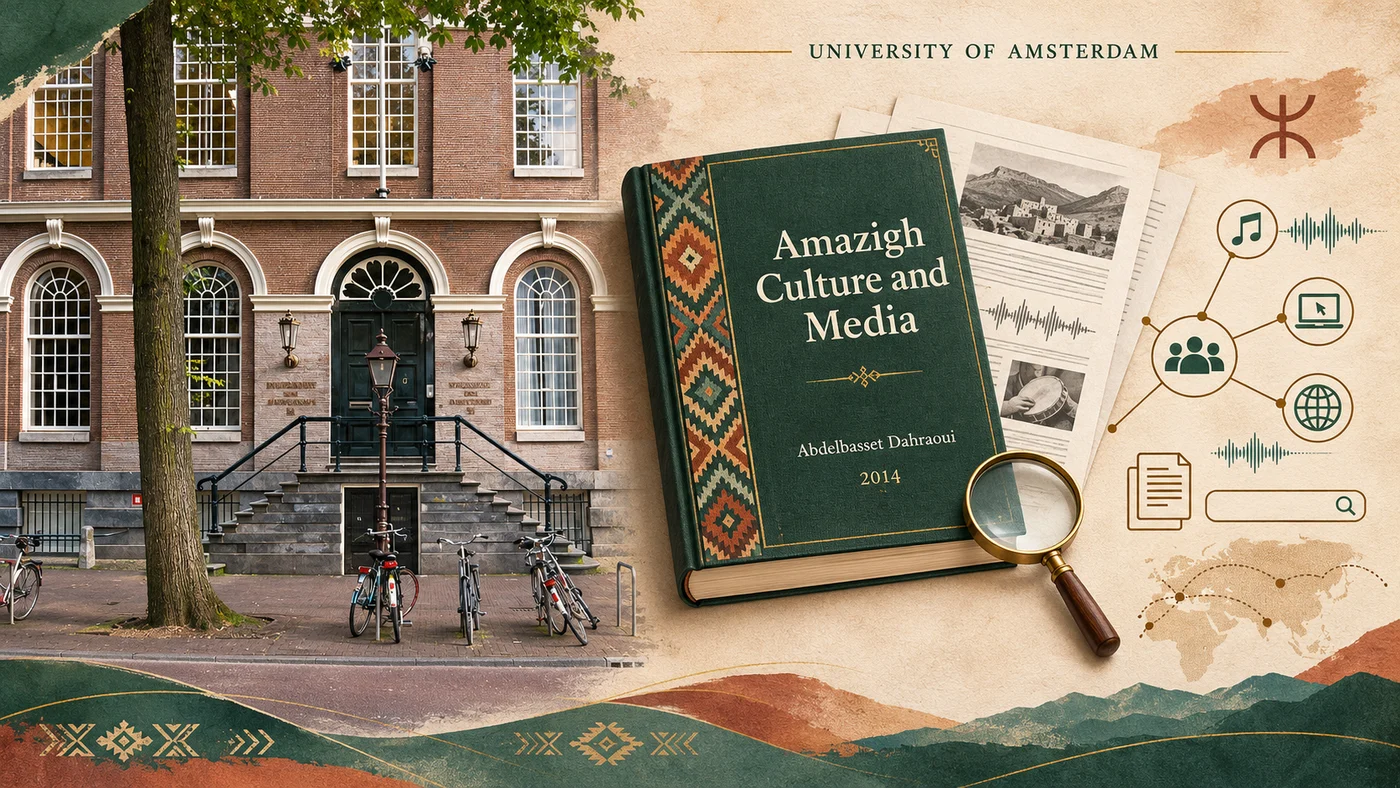
It is moving to see that experience become a subject of academic research. Abdelbasset Dahraoui’s doctoral thesis, Amazigh Culture and Media: Migration and Identity in Songs, Films and Websites, was defended at the University of Amsterdam on 30 April 2014. The university’s Amsterdam School for Cultural Analysis lists the work among its completed doctorates, with Patricia Pisters as supervisor.
University of Amsterdam · ASCA doctoral record ↗
A study of culture across borders
Dahraoui explores migration and identity through songs, films and websites. His website chapter examines Agraw, Dalil-Rif and Timazighin; the Agraw section occupies printed pages 164–177.
For us, that sustained attention is a reason to read the work carefully. Community websites deserve a place in cultural history alongside the performances and publications they help people discover. Their value cannot be measured only by the technology used to build them.
Read the Agraw section in the PDF ↗
The founder’s words: music and the feeling of home
Mohammed Bounda created Agraw in 2000, driven by his love of contemporary Amazigh music and a desire to give it a space beyond the official media. After the project had found success, Hisham Boughaba joined to help edit some articles, while Miloud Ayadi contributed photography and video coverage of selected artistic events for several years. Agraw was founded and conceived by Mohammed Bounda; these later contributions helped support its cultural work.
“because of my love for contemporary Amazigh music”
Mohamed Bounda, interviewed in the thesis · p. 164 ↗
“the urge and need to smell home”
Mohamed Bounda, interviewed in the thesis · p. 167 ↗
For Agraw today, these words are a useful starting point. A recording is never merely an item in a list. Someone remembers when they first heard it; someone else encounters its language for the first time. Keeping a route to that music open is a practical act of cultural care.
The feeling of home also leaves room for curiosity. A listener may arrive for a familiar Rifian voice and continue towards another regional collection. Recognition and discovery can belong to the same visit. That is the kind of listening we want to encourage.
How the researcher reads Agraw
The researcher calls Agraw “a polyphonic space” (p. 165) and a “space for conviviality and social bonding” (p. 172), linking participation, memory and belonging.
That distinction gives us something to think about as editors. Publishing a photograph is one task; helping someone identify the musicians in it is another. Restoring an artist’s name, correcting a date, or reconnecting a recording with its context asks the community to take part in the work.
We do not regard a cultural archive as finished simply because its pages are online. It needs people who remember, people who ask questions, and people willing to correct what is incomplete. A useful archive should make those contributions easier to offer and easier for future readers to find.
Researcher’s description · p. 165 ↗ · Social bonding · p. 172 ↗
Reading the original Agraw from today’s website
This is a 2014 study of an earlier Agraw, not an evaluation of the present redesign.
Today, visitors can move between music collections, stories, videos and photo albums, return to the community chat, or begin exploring Tifinagh. These are different ways into a shared cultural space. Our task is to make them welcoming, readable and worth returning to.
The research invites a personal question for anyone who has spent time here: what did Agraw make possible for you? Perhaps it was a song you could not find elsewhere, a photograph from a gathering, or a friendship that outlasted a late-night chat. Those memories belong to the people who made them.
We welcome recollections, photographs, corrections and stories from the original community. They can help the new website carry more than files forward: the names, relationships and occasions that give those files meaning.
Read our story ↗ · Share a memory with Agraw ↗
Beyond Agraw: the wider questions of the thesis
The Agraw chapter is one part of a wider investigation. Reading it alongside the chapters on music and cinema opens a conversation about what cultural expression can do for people living between places.
Songs as a meeting place between generations
Dahraoui reads Khalid Izri’s Taqeṣṣiṣt Inu (My Story) as a way of carrying collective memory across generations. Remembered games, places and cultural references gain new life in song. His analysis also connects traditional instruments with contemporary arrangements: continuity need not mean repeating the past unchanged (pp. 76–82).
For a listener discovering an older recording today, this suggests a different kind of attention. Alongside the melody, there may be a place name to ask about, an expression to learn, or a family memory to recover. Listening together can begin an exchange that a track description alone cannot supply.
Music, collective memory and change · pp. 76–82 ↗
Migration also shapes the lives of those who stay
In The City of Wait, Dahraoui examines uneven access to movement in Al Hoceima. Waiting concerns work, departure and family reunions, while women’s access to public space raises further questions. Migration is therefore more than a traveller’s journey; it also structures the lives of people who remain (pp. 84, 105, 117).
This is a useful invitation when we encounter a film or a family story about migration: ask whose experience is being shown. A departure can be remembered differently by the person who leaves, a partner waiting for news, and a child growing up between visits.
Cinema, mobility and waiting · chapter III, pp. 84–118 ↗
An online home needs more than one voice
Drawing on Bakhtin’s ideas of dialogism and polyphony, the thesis approaches websites as spaces where different voices interact. An online home offers a provisional sense of belonging through participation, language and shared cultural material, rather than requiring everyone to speak with one voice (pp. 148–149).
For our community, the practical question is how to welcome that variety. Someone may know the history behind a photograph; another may need a translation. A useful gathering place gives both people room, and makes disagreement possible without losing respect for the person speaking.
Home online and dialogue · pp. 148–149 ↗
A culture carried forward, not held still
The conclusion presents Amazigh identity as an ongoing process shaped by migration, representation and social encounters. Cultural continuity and new influences coexist; media can offer temporary stability while people negotiate belonging across places (pp. 191–193).
Read from today’s Agraw, this leaves an open task. Keeping older songs and photographs accessible matters, but so does making space for new work and new listeners. An archive becomes more useful when it helps people connect what they inherit with what they are creating now.
Read the thesis conclusion · pp. 190–193 ↗
Read the thesis
Open the PDF at viewer page 167 (printed page 164). Read the founder’s interviews alongside the researcher’s interpretation, then explore the wider study for yourself.
The research
Amazigh Culture and Media: Migration and Identity in Songs, Films and Websites
Abdelbasset Dahraoui · University of Amsterdam · 2014
Read the complete thesis (PDF) ↗
University of Amsterdam repository record ↗
Questions & answers
Where can I read the research?
Use the full PDF link in the research section, or open the University of Amsterdam repository record.
How can I share an Agraw memory?
Contact Agraw with photographs, recollections or corrections. Please include any names, dates and context you can verify.
Research and short excerpts: Dahraoui’s thesis. Page numbers refer to the printed thesis. Doctoral date and supervisor: UvA / ASCA. This article is Agraw’s editorial reflection on the study.
Featured image: editorial illustration with a stylised thesis cover, not the original cover. Building photograph adapted from Mtcv / Wikimedia Commons. Illustration available under CC BY-SA 3.0.