
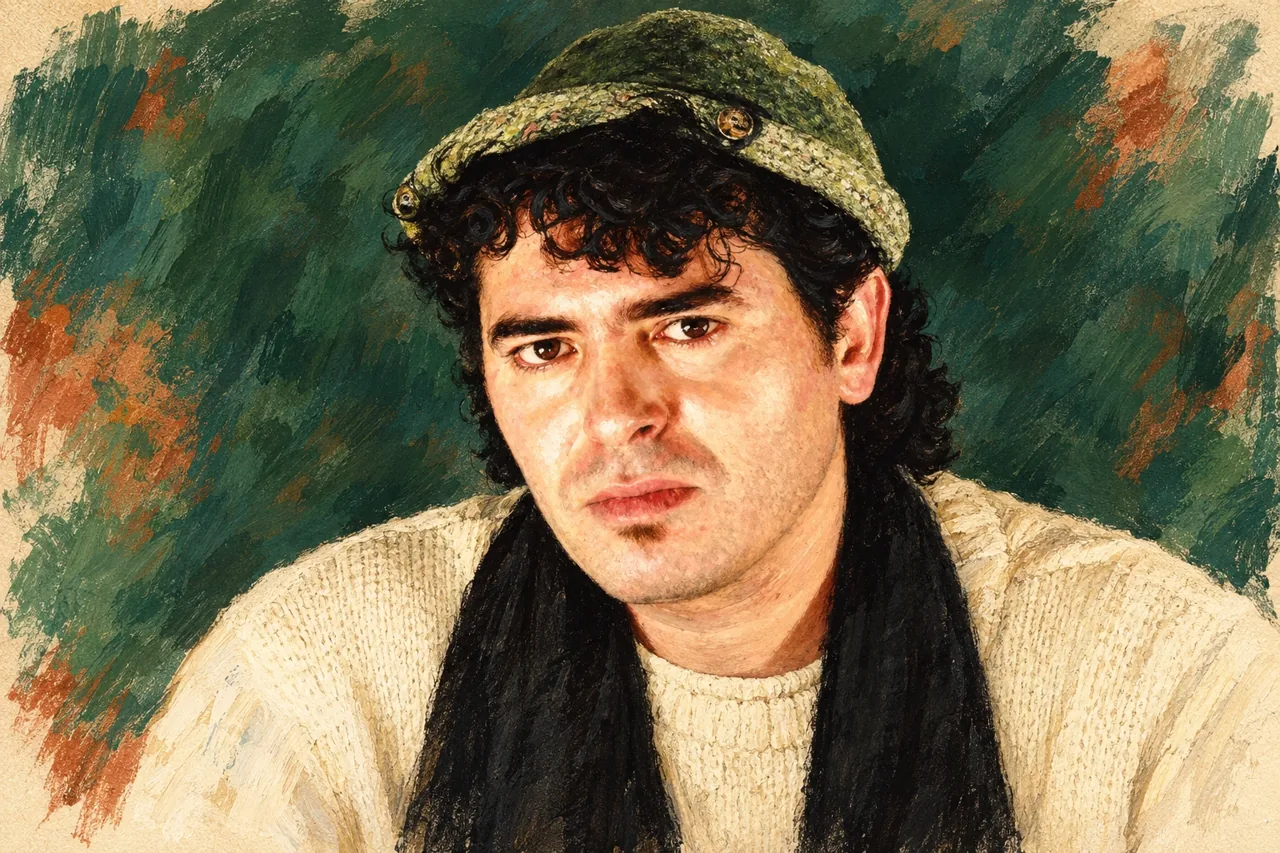
A voice can carry a place without remaining inside its borders. In Khalid Izri’s music, the Rif is a language, a memory and a way of meeting the world. His songs travel outward, bringing the intimacy of a melody into conversation with questions of dignity, belonging and freedom.
Learning to listen, learning to play
Born in Tétouan in 1969, Khalid Izri spent part of his childhood in Melilla, where his extended family had its roots, before growing up in Nador. Music drew his attention early. Without a local music-school education to follow, he learned for himself, finding his way through the guitar, harmonica and percussion.
That beginning matters to the shape of his story. Before there was a professional stage, there was curiosity: the desire to understand an instrument, to find a phrase, to turn something heard into something played. His musical education began with that patient, practical relationship between the ear and the hand.
A language that refuses to disappear
Growing up in a political climate that marginalised Amazigh identity and culture, Izri’s interest in his roots gradually became a deeper awareness. He has not needed to present himself primarily as a political militant to recognise the significance of his choice of language. In such a context, singing in Tamazight could itself be an act of affirmation.
He sings in Tarifit, bringing the language of the Rif into contemporary songwriting. The choice is artistic and personal as well as public: a language lives through the things people create in it, the emotions they trust to it and the audiences they invite to hear it.
Between inherited sounds and open horizons
Izri’s musical world brings traditional Amazigh elements together with classical and modern instruments. Folk and pop provide part of its pulse, while Celtic and jazz influences widen its possibilities. The result is an approach in which cultural inheritance becomes material for invention.
There is room here for gentleness and insistence in the same song. A soothing melodic line need not soften the question carried by its words. That relationship between musical warmth and serious subject matter is central to the portrait of Izri as both composer and singer.
Commitment in the shape of a song
Women’s rights, migration, minority identities and xenophobia belong among the concerns his work addresses. His commitment to the right of people to sustain their cultures reaches beyond one community, even as his own Amazigh identity remains close to the centre of his music.
Rather than making the song merely a vehicle for a slogan, he builds a musical setting in which these concerns can be felt. A listener may first enter through the rhythm or the voice and stay to consider the words. For an artist working across languages and borders, that invitation is a powerful one.
The journey continues across the sea
Life in Europe has extended Izri’s artistic horizons and brought his music to audiences beyond North Africa. Distance from the Rif has not removed it from his work. It has given its language and memories new places in which to resonate.
His creative path also reaches cinema: Khalid Izri is credited with the music for Adios Carmen, Mohamed Amin Benamraoui’s film set in the Rif. Song and film meet here in their ability to carry a place into another person’s imagination.
For Agraw, his work belongs in a gathering of voices that are rooted and outward-looking at once. The next step is to listen.
Questions & answers
Where did Khalid Izri grow up?
Born in Tétouan in 1969, Khalid Izri spent part of his childhood in Melilla before growing up in Nador. He taught himself guitar, harmonica and percussion.
What language does Khalid Izri sing in?
He sings in Tarifit, bringing the language of the Rif into contemporary songwriting. His music combines traditional Amazigh elements with folk, pop and other musical influences.